


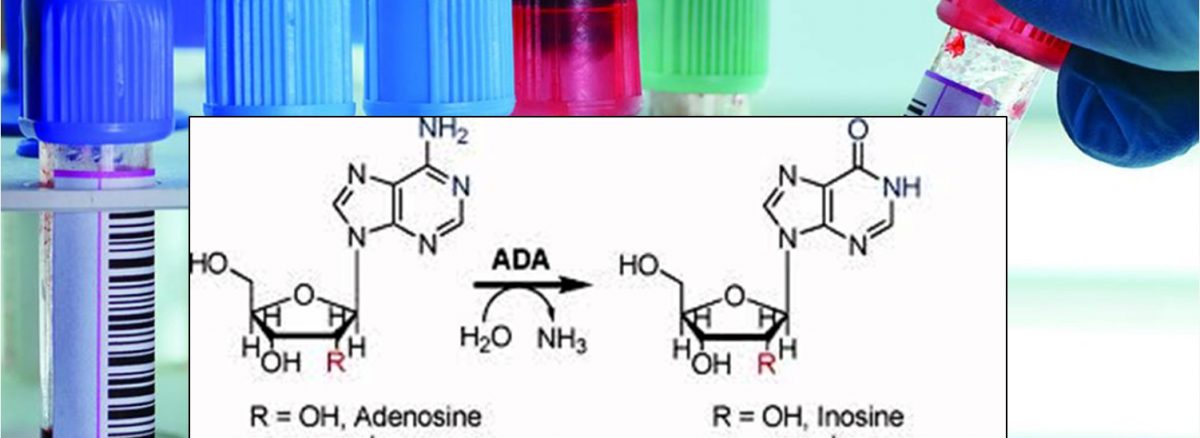
ADENOSINE DEAMINASE (ADA)
ADA is an enzyme that catalyzes the deamination of adenosine to inosine.
ADA is an enzyme that catalyzes the deamination reaction of adenosine to inosine. It is also an important enzyme in the purine catabolic pathway
. ADA has two isoforms: ADA-1 and ADA-2.
ADA-1 is found in many tissues, including red blood cells. ADA-2 is found exclusively
in macrophages and monocytes 1,2.
ADA activity is 10 times higher in lymphocytes than in erythrocytes. T-
s are present in higher concentrations in T lymphocytes than in B lymphocytes, and there is also a marked increase during T-cell differentiation
, particularly during the immature and undifferentiated stages. Consequently,
many researchers have demonstrated that ADA is a marker of cellular immunity and, as a result, have shown elevated serum levels in various
diseases. Elevated serum ADA activity has been observed in many diseases where cellular
immunity is activated. These diseases include typhoid fever, infectious mononucleosis,
sarcoidosis, liver diseases, acute leukemia, brucellosis, acute pneumonia, rheumatoid arthritis, and various
malignancies 3. With regard to the liver, elevated serum ADA levels have been observed in patients with acute hepatitis, alcoholic hepatic
fibrosis, chronic active hepatitis, liver cirrhosis, viral hepatitis, and hepatoma 4,5.
ADA plays a role in the proliferation and differentiation of lymphocytes, particularly T lymphocytes. It also influences the maturation of monocytes
by converting them into macrophages. ADA is an important marker of active cellular
immunity. It increases in biological fluids during infectious diseases
characterized by microorganisms that infect macrophages. For example, ADA deficiency in humans primarily manifests as severe
lymphopenia and immunodeficiency 6. Furthermore, it has been proposed
that ADA is a useful surrogate marker for TB because it can be detected in body fluids such as pleural, pericardial, and peritoneal fluid
. ADA levels rise in TB
due to the stimulation of T cells by mycobacterial antigens 2.
Total ADA and ADA-2 activities have been found to correlate with each other
in both healthy individuals and those with immune-mediated diseases (RA,
SLE, ankylosing spondylitis, myasthenia gravis, and autoimmune liver diseases). Values were found to be significantly elevated in patients.
Additionally, activity levels were measured to be significantly higher
in children under 18 and in individuals over 60 years of age.
ADA is a candidate for a key biomarker of Macrophage Activation Syndrome (MAS) 7.
Considering the points mentioned, we believe that the clinical
utility of ADA—a key enzyme in purine metabolism—should be greater than it is now.
REFERENCES:
1. Kaya S, Cetin ES, Aridogan BC et al. Adenosine deaminase activity in the serum of patients with
hepatitis—a useful tool in monitoring clinical status. J Microbiol Immunol Infect 2007; 40: 288-92.
2. Gakis C. Adenosine deaminase (ADA) isoenzymes ADA1 and ADA2: diagnostic and biological role.
Eur Respir J 1996; 9: 632-3.
3. Baganha, M.F., Pego, A., Lima, M.A., Gaspar, E.U., Pharma, B.: Serum and Pleural Adenosine-
-Deaminase Correlation with Lymphocytic Populations. Chest, 97(3): 605-610, 1990.
4. Kobayashi F, Ikeda T, Marumo F, Sato C: Adenosine deaminase isoenzymes in liver disease. Am. J.
Gastroenterol. 88: 266-271 (1993)
5. Kallkan A., Bult V., Erel O., Avci S., and Bingol N. K.: Adenosine deaminase and guanosine-
e deaminase activities in the serum of patients with viral hepatitis. Mem Inst. Oswaldo Cruz 94(3): 383–386
(1999)
6. Cimen F, Ciftci TU, Berktas BM et al. The relationship between serum adenosine deaminase levels
s in pulmonary tuberculosis, along with drug resistance and the category of tuberculosis. Turkish Respir J
2008; 9: 20-3.
7. Zhao-Wei Gao, Xi Wang, Fang Lin, Ke Dong. Total adenosine deaminase is highly correlated with
adenosine deaminase 2 activity in serum. http://dx.doi.org/10.1136/annrheumdis-2020-217007